Why Cut-Offs Matter

Gregg Hanour

(Part of the “Drunk, Drunker, and High-Risk Drunkenness” series)


Three Truths of Cut-Offs


  1. Cutting off obviously intoxicated customers saves lives.
  2. Whether you’re a city official, employed in law enforcement, work for the ABC, a member of the hospitality industry, or someone who can influence these organizations—you have the power to significantly increase cut-offs of drunk customers.
  3. In other words: YOU can save lives.


Let that sink in.


Understanding Relative Crash Risk


It’s been eye-opening — and sometimes jaw-dropping — when I hear versions of this question in meetings with DUI task force members, police chiefs, mayors,  or other city officials:


   “Why are you so focused on cutting off people who are already drunk? Isn’t it already too late?”


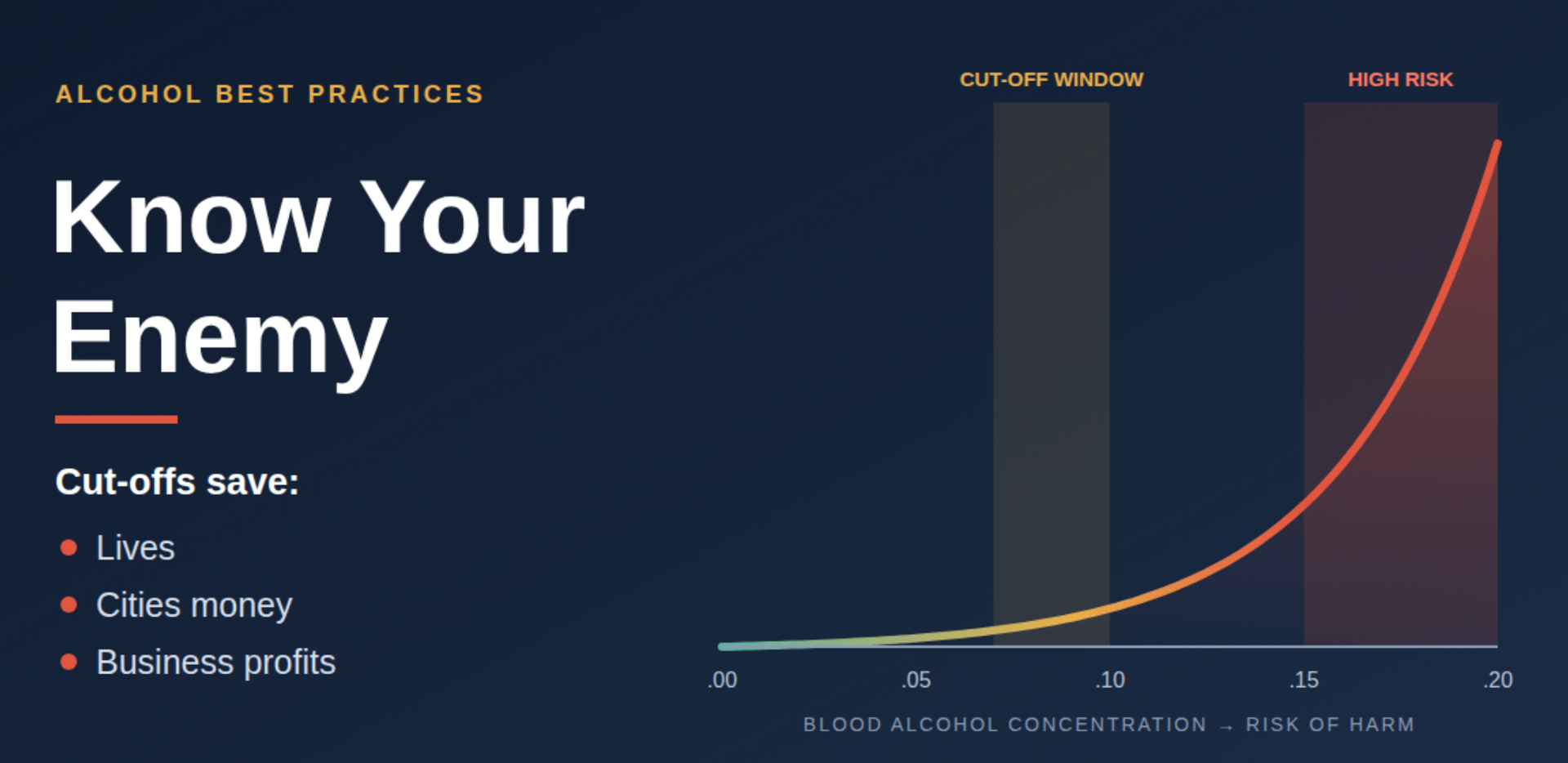
As a person’s blood alcohol content (BAC) rises, the risk of harm to themselves and others rises exponentially.


The chart below illustrates the sharp increase in crash risk as a driver’s BAC climbs, compared to the baseline risk of a non-drinking driver.
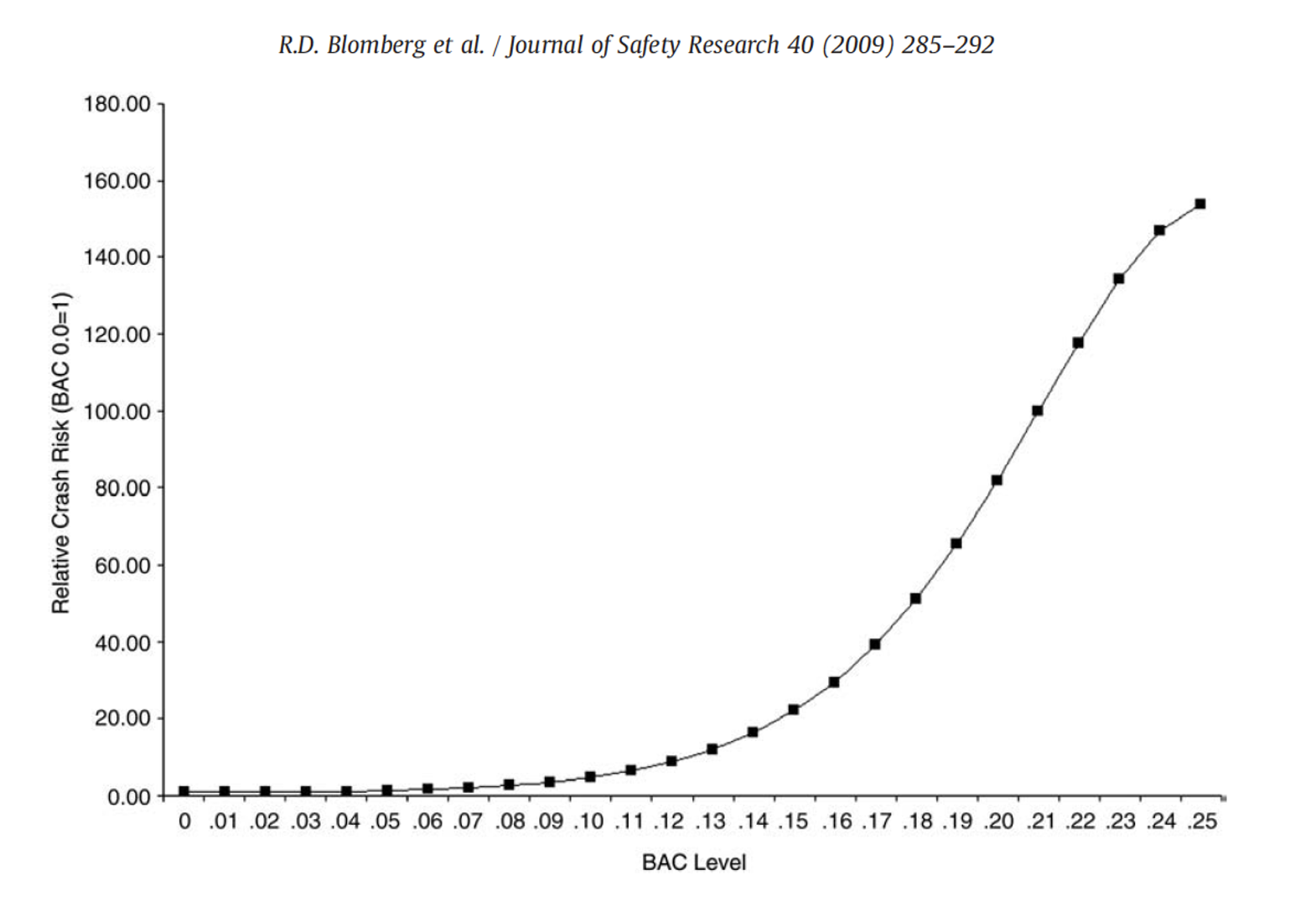


Relative risk compares the likelihood of harm in an "exposed" group to that of a "non-exposed" group. In this case, the exposed group consists of drivers who have consumed varying amounts of alcohol; the non-exposed group are drivers who have not been drinking.


Let’s zoom in on the lower BAC levels:
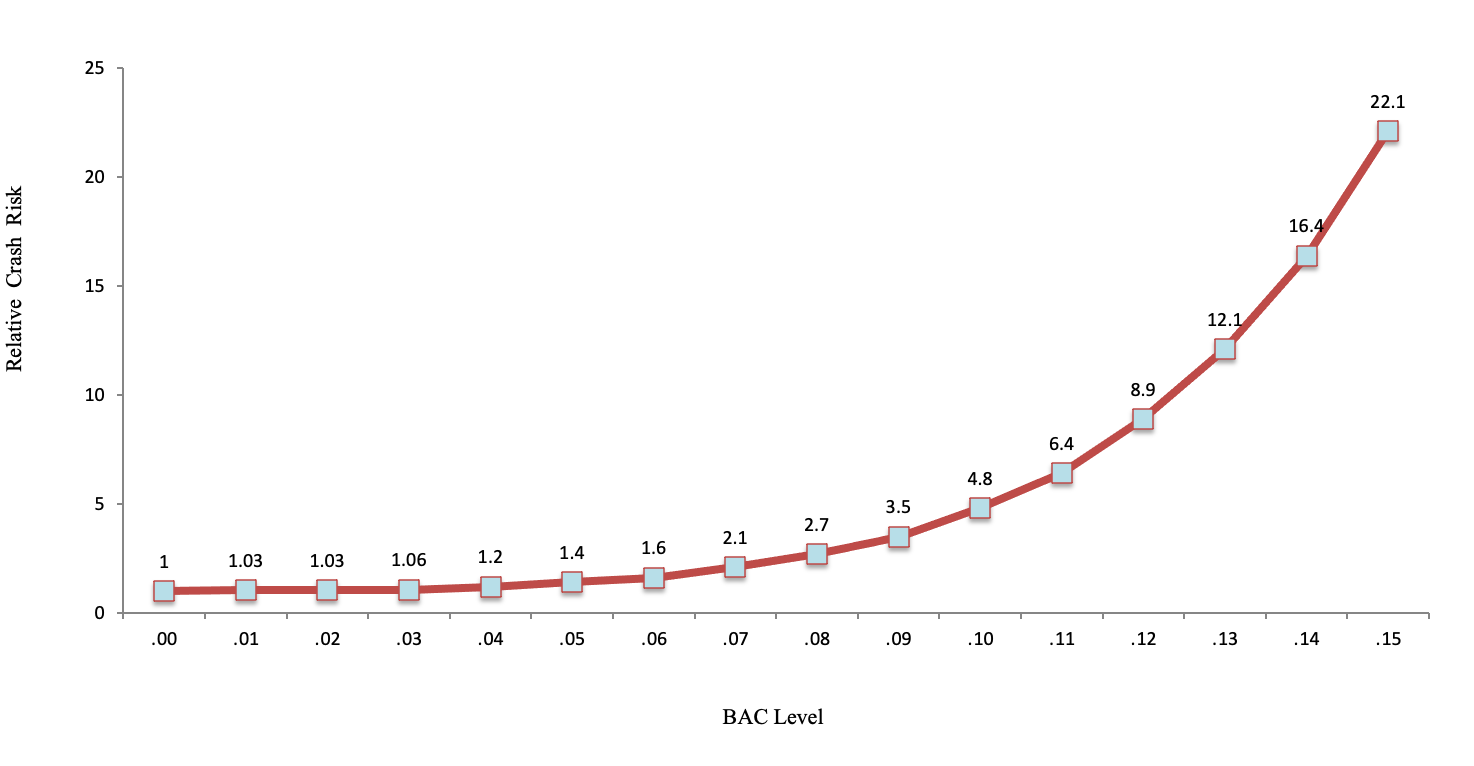


At a BAC of .07%, a drinking driver is 2.1 times more likely to crash than a non-drinking driver.


A drinker who consumed enough alcohol to progress through the initial eight BAC levels (.00 to .07) is 2 times more likely to crash than before drinking. If that drinker isn’t cut off and continues to drink enough alcohol to progress through the next eight BAC levels (.08 to .15), the driver is now 22 times more likely to crash than before drinking.


High-Risk Intoxication is Often Deadly


When a death occurs in an alcohol-related crash, 70% of the time the driver’s BAC is .15% or higher—a level considered high-risk intoxication.


Alarmingly, about half of alcohol-related crashes involve drivers who had their last drink at an ABC-licensed business, according to "place-of-last-drink" studies.


How Cut-Offs Save Lives and City Resources


Cutting off obviously intoxicated customers can dramatically reduce deaths caused by impaired driving. The benefits go beyond reduced DUI tragedies:


  • Reduced calls to first responders for disturbances and fights inside alcohol establishments, in surrounding neighborhoods, and where drunk customers arrive afterwards


  • Fewer public safety issues caused by intoxicated individuals


It’s Sad, But True


Despite the tremendous benefits that cut-offs bring to everyone—customers, businesses, communities, and public safety—they rarely happen.


We’ll explore why in our next Insight.


INSIGHT RECAP


  • Cutting off obviously intoxicated customers is critical because the risk of harm surges exponentially as intoxication rises.


  • When a death occurs in an alcohol-involved vehicle crash, 70% of the time, a driver had a BAC of .15% or higher.


  • Increasing cut-offs will reduce DUI tragedies, public harm, and police calls for service.


  • YOU can take action to save lives.


Coming in This Series:


  • Cut-offs and Reality
  • How the ABC Can Influence Cut-offs
  • How City Officials Can Influence Cut-offs at New Businesses
  • How City Officials Can Influence Cut-offs at Existing Businesses
  • How to Guide Businesses to Increase Cut-offs
  • How Cut-offs Reduce Customer “Churn” (Turnover)


By Gregg Hanour • October 6, 2026
That's the decision . . .
By Gregg Hanour • September 28, 2026
In our last blog we discussed how the overconsumption of alcohol is the enemy, not the moderate consumption of alcohol. Moderate Drinkers are Safer Multiple research studies have shown that people who consume alcohol and keep their BAC to below .06% are safer. “There is agreement in the scientific community about what defines ‘moderate drinking.’ Also, moderate drinking means limiting how fast you drink and, as a result, keeping your blood alcohol concentration (BAC) below .055.” (Source: Hester) In general, those who drink excessively are more aggressive and also get injured more seriously than those who drink moderately or not at all. Moderate drinkers do not appear to be at significantly higher risk of injury than nondrinkers. (Source: Scott and Dedel) The Higher the BAC, the Greater the Risk of Harm Alcohol follows a dose-response curve— higher BAC leads to higher risk across all major harms, including crashes, injuries, and violence. Harm rises exponentially as demonstrated by this chart from National Highway Traffic Safety Administration on the risk of crashing at given BAC levels.
By Gregg Hanour • September 22, 2026
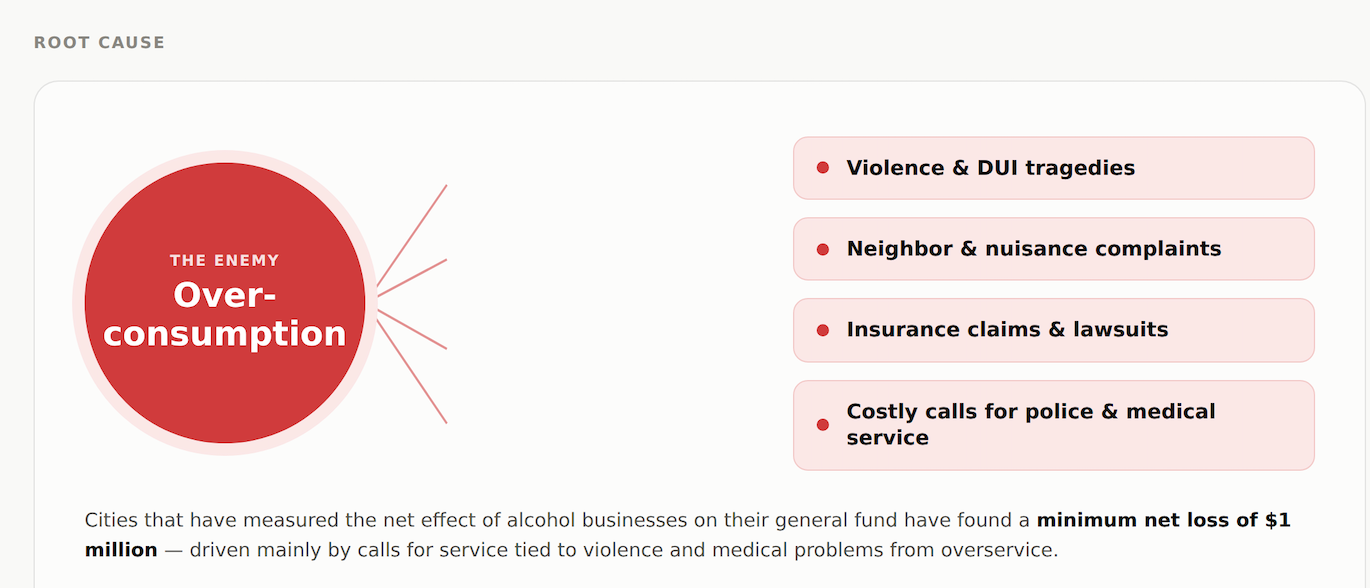
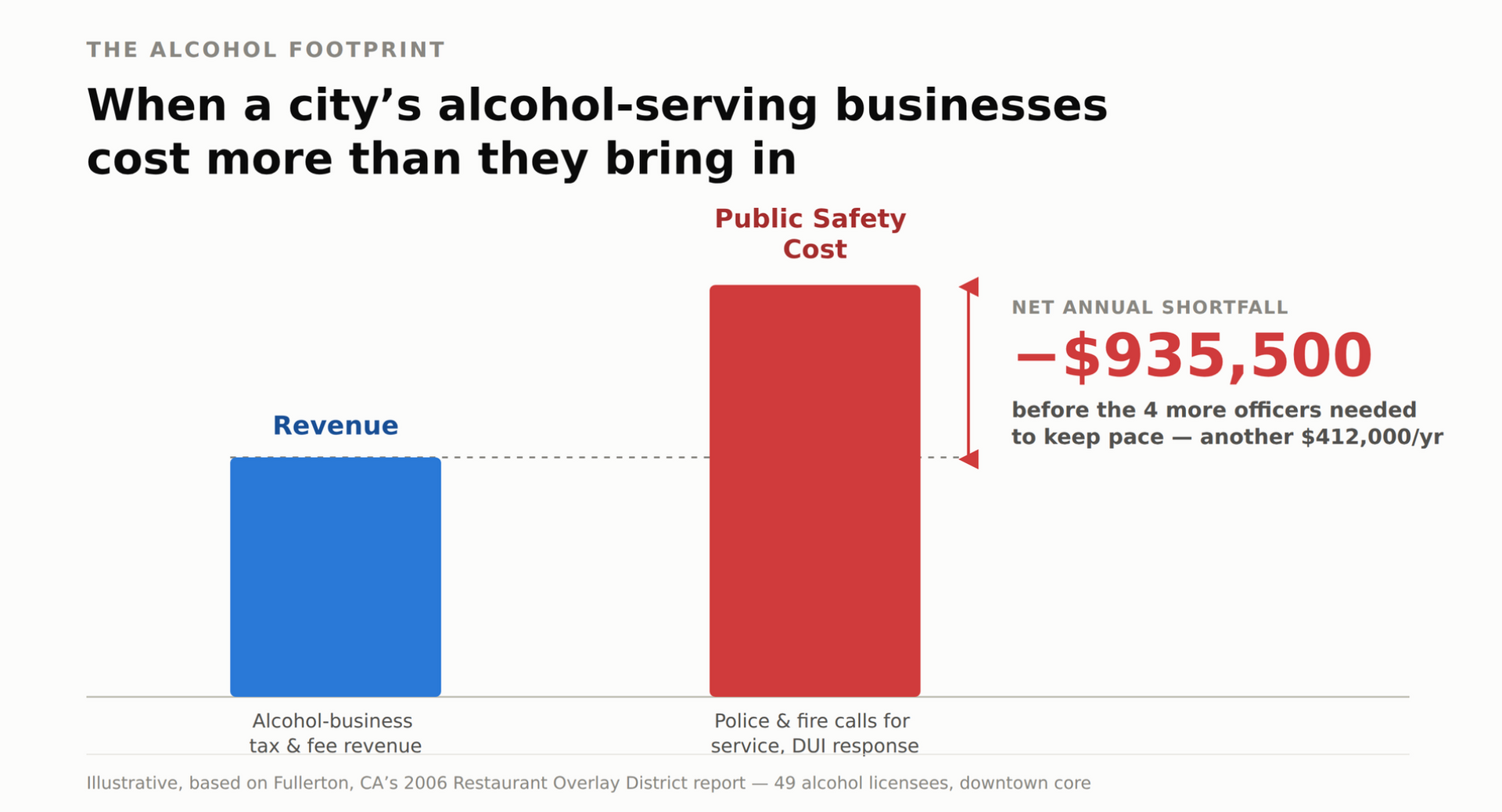
The Root Cause: Overconsumption of Alcohol T he main purpose of CUP conditions for your on-sale alcohol businesses is to lessen any negative impacts and ensure the operation is in harmony with your community Most problems caused by your bars and restaurants are the direct result of the overconsumption of alcohol—including altercations, nuisance complaints from neighbors, and vehicle crashes. Cities that have calculated the net effect of alcohol businesses on their general fund have discovered a minimum net loss of $1 million dollars—caused mainly by calls for service due to violence and medical problems from overservice. The insurance industry says that 90% of insurance claims at bars and restaurants are the direct result of the overconsumption of alcohol. My experience as an operator and consultant to the hospitality industry suggest that 90% of the time, calls for service are due to one or more customers having consumed too much alcohol. Studies confirm the relationship between higher levels of intoxication and violence. Using Logic to Choose an Action to Solve the Problems Since the goal of writing conditions of approval is to lessen problem . . . And since most problems stem from the overconsumption of alcohol . . . Shouldn’t the conditions aim to lessen overconsumption? In fact, shouldn’t a major focus of your entire approval process—from approving, conditioning, and onboarding—be to message best practices to lessen overconsumption? In reducing the overconsumption of alcohol, all stakeholders benefit: Public safety is improved from less violence and fewer DUI tragedies. City public safety expenses are reduced. Business profits are protected from insurance claims and lawsuits. There are many ways planners and law enforcement can reduce overconsumption in newly-approved on-sale alcohol businesses. In reducing overconsumption, your city saves money—lots of money. This isn’t just our opinion. A Study to Bank On According to this study, for every $1 a city spends to reduce intoxication, it saves $260 (Levy & Miller)
By Gregg Hanour • September 15, 2026
Most city leaders assume their bars and restaurants pay for themselves. The numbers say otherwise—and closing the gap starts with rethinking two common assumptions.
By Gregg Hanour • September 9, 2026
Most city leaders assume their bars and restaurants pay for themselves. The numbers say otherwise — and closing the gap starts with rethinking two common assumptions.
By Gregg Hanour • September 2, 2026
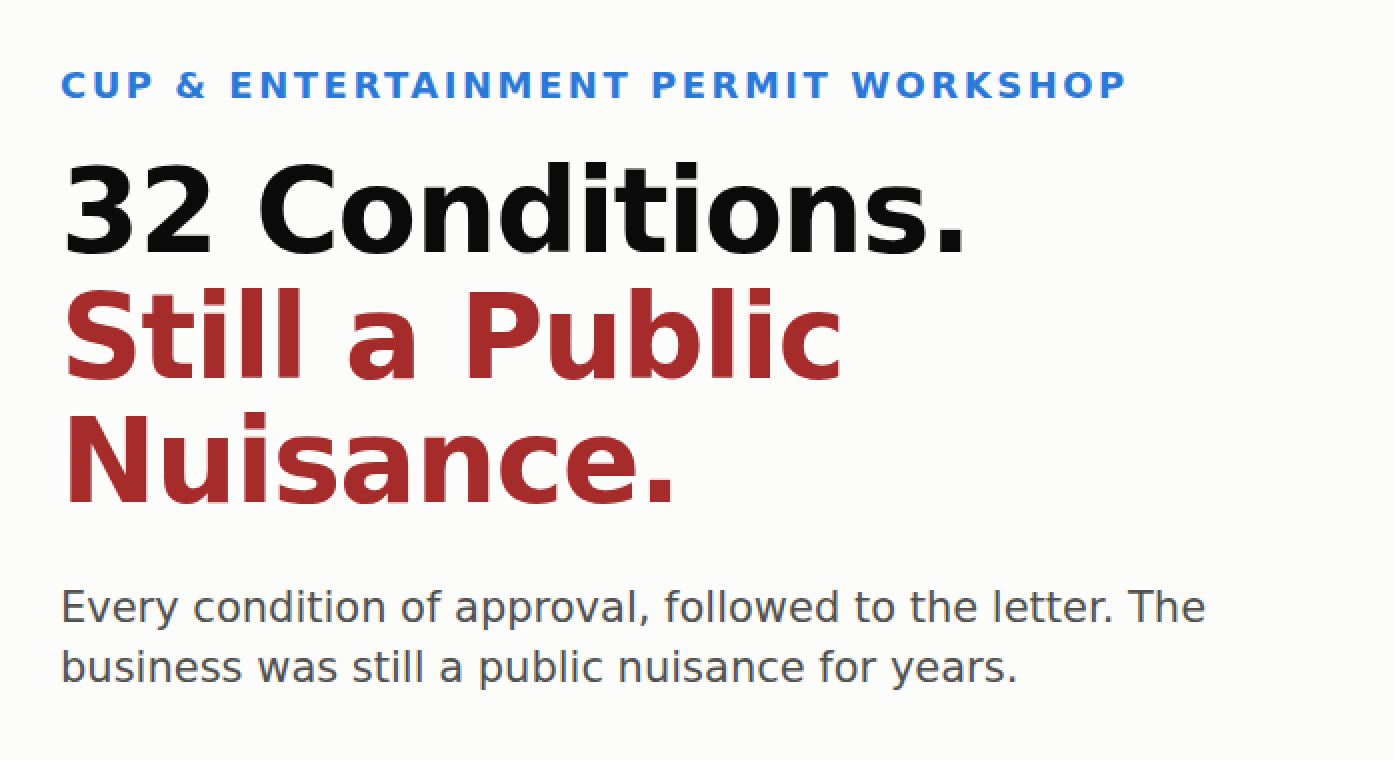
I’ve been known to get a little obsessed with reaching goals — whether it’s catching a trophy brown trout over 10 pounds or hitting a Pick 6 for more than $50,000. Did I accomplish those goals? You’ll find out at the end. Another goal of mine is far more important and challenging: changing how California cities approve, condition, and onboard new on-sale alcohol businesses (restaurants, bars, clubs, and similar establishments). That's why I teamed with retired ABC District Administrator Lauren Tyson to design our upcoming workshop on best practices for conditional use permits (CUPs) and entertainment permits. The current process sucks. Yes, I sometimes use technical language. Who’s Behind This? I’ve spent years training hospitality operators, planners, and law enforcement on exactly this problem, and wrote a book on the topic, A Business Approach to Reducing DUI, along the way. Link to Gregg’s bio Lauren wrote the book on it — literally. As a former ABC District Administrator and author of Perils of Selling Alcohol: A Guide for Bar Owners Facing Legal Trouble, she’s seen exactly what puts ABC-licensed businesses at risk, and what actually protects them and the public. Link to Lauren’s bio How Do I Know the Current Process Isn’t Working? Let Me Count the Ways Personal experience. I went through the process twice — once in Costa Mesa and once in Irvine. In both cases, very smart, dedicated planners, working with law enforcement, created extensive conditions of approval. One business had 32 separate conditions. Both businesses followed every condition, yet both were still public nuisances for years. Working with applicants. Lauren and I have helped dozens of applicants successfully navigate their city’s CUP application process. Yet the operating conditions cities impose rarely (read never) have a meaningful impact on reducing violence or problems. Reviewing city policies statewide. We’ve collected CUP conditions and operating requirements from 35 cities across California, including several known for leading the way in responsible ordinance writing. The reality? A business can follow every specific condition of approval and still become a public nuisance. Training professionals. We’ve conducted in-person workshops for planners and law enforcement on this topic. Presenting at conferences. Together and separately, we’ve presented on these issues at professional conferences. Academic research. While writing my first book, A Business Approach to Reducing DUI, I researched the topic extensively, including contacting five of the leading urban planning universities to review their curriculum. Working directly with operators. I’ve trained over a thousand hospitality owners and managers. I understand their concerns, their daily realities, and why too many close. Revising how cities approve, condition, and onboard new businesses doesn’t just protect city resources and public safety — it also guides businesses toward practices that improve their profitability. The Bottom Line When cities use best practices to approve, condition, and onboard new on-sale alcohol businesses, the outcome looks very different. Applicants who complete the CUP process and open for business will hear consistent messaging — from planners, planning commissioners, code enforcement, and law enforcement — about the operational practices that significantly reduce violence and problems. Applicants will receive meaningful conditions of approval that, when followed, actually reduce risk for all stakeholders. Applicants will experience impactful communication with code enforcement and law enforcement that keeps the operator focused on practices that protect both the business and the community. That’s what effective onboarding looks like. We hope you’ll join us for our upcoming Zoom workshop. And if you twist my arm, I might even share a few brown trout fishing tips. Yes, I did catch that trophy brown — a 17-pound, 7-ounce beauty. I also hit that big Pick 6. If you ask how to hit a $50,000 Pick 6 at the racetrack, my advice is simple: Start with a $100,000 bankroll. WORKSHOP Conditional Use Permits, Entertainment Permits, and On-Sale Alcohol Oversight 📅 Date: Wednesday, October 28, 2026 🕐 Time: 10:00 a.m. – 12 Noon Pacific Time (2 Hours) 📍 Location: Live via Zoom ✅ POST Certification pending | APA Certified 2.0 CM COST -$330 per attendee; or -$990 flat rate per city (up to 10 attendees from your city) Learn more Register for the workshop WHO SHOULD ATTEND This workshop is designed for professionals responsible for reviewing, approving, or monitoring alcohol licenses, including: • City planning officials • Law enforcement personnel • Code enforcement officers • Planning commissioners Everyone involved in approving, conditioning, or onboarding new ABC on-sale licensed businesses must deliver a consistent, informed message at every step of the process — this workshop ensures they can. We offer a significantly reduced tuition for a group because the gains from this workshop grow exponentially when every department is trained together.
By Gregg Hanour • August 24, 2026
Alcohol Best Practices is pleased to announce a new Zoom workshop for public officials and law enforcement professionals involved in alcohol license oversight. Conditional Use Permits, Entertainment Permits, and On-Sale Alcohol Oversight 📅 Date: Wednesday, October 28, 2026 🕐 Time: 10:00 a.m. to 12:00 Noon,Pacific (2 Hours) 📍 Location: Live via Zoom (link emailed upon registration) ✅ POST Certification pending | APA Certified 2.0 CM COST -$330 per attendee -$990 flat rate per city (up to 10 attendees) Learn more Register for Workshop WHO SHOULD ATTEND This workshop is designed for professionals responsible for reviewing, approving, or monitoring alcohol licenses, including: • City planning officials • Law enforcement personnel • Code enforcement officers • Planning commissioners Everyone involved in approving, conditioning, or monitoring new ABC on-sale licensed businesses must deliver a consistent, informed message at every step of the process — this workshop ensures they can. WHY THIS WORKSHOP IS NEEDED After analyzing dozens of Conditional Use Permits (CUPs) from cities across California, we identified critical gaps in how cities handle new alcohol license approvals: Existing CUP processes lack essential messaging to applicants Legacy approval conditions miss the most impactful requirements Newly approved businesses receive little to no meaningful onboarding Until now, there has been no training resource for best practices in approving, conditioning, or monitoring new ABC on-sale licensed businesses. Contracting with us to revise your city's approval and onboarding process is a significant investment. This workshop offers a cost-effective alternative, equipping your team with proven strategies that: ✔ Reduce violence, DUIs and nuisance complaints ✔ Lower public safety expenses and calls for service ✔ Improve the profitability, performance, and professionalism of licensed businesses We look forward to seeing you there. Learn More Register for Workshop
By Gregg • January 6, 2026
(Insight in the “Drunk, Drunker, and High-Risk Drunkenness” series)
By Gregg Hanour • December 12, 2025
(Insight in the “Drunk, Drunker, and High-Risk Drunkenness” series) 
By Gregg Hanour • November 24, 2025
(Insight in the “Drunk, Drunker, and High-Risk Drunkenness” series)